


-
- English
- Deutsch
- Spanish
-
- General Diagnostics
- Treatment
- Tools/Materials
- Basic/General Knowledge
- Research
- Events
- Organisations
-
-
-
-
-
-

-

Augmentation at site 16 using the SonicWeld Rx System
Iglhaut, Gerhard M. -
Piezo Surgery Technique for Alveolar Ridge Augmentation with Sinus Lift
Schlee, MarkusOverview: - Periodontal and implant planning - Treatment of a horizontal and vertical bone defect - discussion of the literature - Clinical implementation of bone augmentation using a bone block and treatment of a vertical pocket with Emdogain - Sinus lift in combination with alveolar ridge augmentation and horizontal expansion of the alveolar process; orthodontic straightening of a molar tooth Contents: This contribution illustrates a complex periodontal-implantological case, from treatment planning to clinical implementation. It details the transplantation of two bone blocks from the linea obliqua of the angle of the jaw to the anterior front tooth region, the treatment of a vertical bone pocket with Emdogain, the straightening of a molar tooth using orthodontic mini-implants, and a sinus lift together with alveolar ridge augmentation in the maxillary region using a piezo surgical technique. -
Minimally Invasive Implant Surgery based on Three-Dimensional CT Treatment Planning for Total Rehabilitation
Beck, FrankProcedure: - Incision Technique 36, 44 - Gentle Flap Mobilization - Pilot Hole Preparation using a CT Template - Sequential Preparation and Implantation - Bone Removal and Augmentation - Wound Closure Contents: Systematic Total Rehabilitation is very challenging, especially in patients with Periodontal Disease with Loss of Supporting Structures. Precise Treatment Planning is essential. The Treatment of Periodontal Disease begins after Conservative Pretreatment. It is not possible to predict the Soft Tissue Esthetic Outcome before the Healing Process is completed. We selected Endosteal Implants for the Augmentation of Lost Support Zones in this Atrophic Mandible. A Three-Dimensional Analysis was performed as the Basis for Navigated Implantation. After Completion of the Periodontal Treatment and Implantation, the patient must wait for approximately 6 months for the Completion of the Healing Process before Prosthetic Reconstruction Procedures can be initiated. -

Implantation with Simultaneous Augmentation
Grunder, UeliProcedure: - Case evaluation - Incision technique - Implant placement - Membrane adjustment and fixation - Introduction of replacement material - Flap mobilization - Suture technique Contents: Implantation was desired for replacement of a missing upper canine tooth and the adjacent lateral incisor tooth. The initial case evaluation revealed a relatively narrow gap between these two teeth in addition to extensive hard and soft-tissue defects. We selected an incision technique that made it possible to do the augmentation work yet subsequently achieve a tension-free flap closure. Since the bony defect was large while the available space was limited, we had to go for the best possible compromise in regard to implant insertion. After the implants had been inserted, augmentation was carried out using a non-absorbable, titanium-reinforced membrane, bone replacement material, and an absorbable membrane. Extreme flap mobilization was needed to achieve flap closure. An optimal suture technique was used to complete the surgery. -
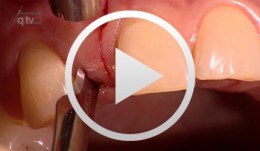
Single Tooth Replacementwith Implants in the Esthetic Region
Yüksel, OrcanProcedure: Delayed loading of dental implants in the esthetic zone of the maxilla. Guided bone regeneration (GBR) for compensatory augmentation with subsequent exposure after healing. Contents: Soft and hard tissue loss leads to esthetic problems, even in patients with successful implant osseointegration. Delayed loading of dental implants in the esthetic zone is frequently indicated in dental practice, for example, in patients with congenital absence of the lateral incisors. Dental implants can solve this problem. Depending on the extent of hard tissue loss, it may be necessary to perform guided bone regeneration (GBR) in order to achieve better esthetic results. Depending on the degree of atrophy, GBR may be performed before or simultaneous with implantation. Correct implant placement is essential to achieving the end goal: an esthetically pleasing and natural result. In this film and in the presentation, we will demonstrate in detail the procedure for placing implants in this esthetically sensitive region. In addition, we will demonstrate a method of impression-taking that provides dental laboratories a better foundation for achieving excellent esthetic results. -
Ballon Lift Control - A life report
Heuckmann, Karl-Heinz -
Internal Sinus Lift with the Lift Control System
Streckbein, Roland -
-
Immediate Function with NoblePerfect Implants
Nölken, RobertProcedure: - Extraction of upper front teeth not suitable for preservation - Immediate loading of four NobelPerfectTM implants - Intraoperative registration of implant position - Flap-free Vestibular Bone Augmentation - Connective Tissue Graft for Periodontal Regeneration - Immediate Loading of temporary implants on the day of surgery - Definitive restoration 6 months later Materials: NobelPerfect Groovy Implants RP and NP; NobelPerfect Temporary Abutments RP and NP; NobelPerfect Implant Replicas RP and WP; Ribbond, Bondable Reinforcement Ribbon; Ethilon 5-0 FS3 Suture Material; Astra Bonetrap Bone Collector. -
Prosthetic Planning and Prosthetically Guided Minimally Invasive Implantation
Rammelsberg, Peter / Hassel, AlexanderContents: - Considerations for prosthetic treatment planning (PowerPoint) - Production of the drill guide according to prosthetic specifications (PowerPoint) - Surgical procedure (film) - Flapless surgery - Access preparation - Pilot drilling using the drill guide - Preparation of the implant site - Internal sinus lift - Implantation Materials Checklist: Pilot drill; Alignment pin, depth gauge Straight osteotome for bone condensation (Ø 3.5 mm); Larger drills to enlarge the osteotmy; Round burs; Osteotome, angled, for sinus lift (Ø 4.2 mm); Ratchet, adaptor for ratchet (short); Holding key for transmission, SCS screwdriver (short); STRAUMANN Standard Plus RN implant (Ø 4.1 mm, L: 12 mm) and healing abutment (2 mm); STRAUMANN Standard Plus WN implant (Ø 4.8 mm, length 12 mm) and healing abutment (3 mm); Scalpel blade (15c) and scalpel blade holder (Martin); Two dental mirrors and dental forceps; Surgical forceps; Anatomical forceps; Probe; Periodontal probe; Sharp spoon; Sterile compresses (Hu Friedy); Isotonic sodium chloride solution, 0.9% (Braun). -
Preimplant Augmentation Procedures to Improve the Hard Tissue Situation in the Upper Anterior Region
Mayer, MatthiasContents - Flap design according to the layering technique - Piezoelectric bone surgery - Bone spreading with osteotomes - Augmentation and suturing Materials Checklist: Piezo surgery unit (ADS); Osteotome (Altatec GmbH); Surgical tray, individual. -
Regenerative Treatment of Class II Mandibular Furcation Defects
Heinz, BerndProcedure Case description: -Class II furcation defect at teeth 46 and 47 and gingival recessions at teeth 43 and 44 - Root planing using PerioSet - Incision technique - Cleaning furcation defect at tooth 46 - Pref Gel application, rinsing and Emdogain application - Insertion of Bio-Oss into the furcation space with an amalgam plugger after hydration - Condensation of the bone replacement material and application of an absorbable membrane (Bio-Gide) - Atraumatic suture closure using 6/0 Seralene Contents: This video demonstration shows the simultaneous treatment of recessions at teeth 43 and 44 and of class II furcation defects at teeth 46 and 47. After a brief case description, root planning is done using PerioSet. Next, an incision is made and the furcation defects are very carefully cleaned using hand instruments and ultrasonic scalers (Soniflex). The cleaned root surfaces and furcation defects are conditioned with Pref Gel (Straumann) for two minutes. The objective of conditioning is to remove the smear layer, to open the dentine tubules, and to enable surface demineralization. Moreover, this measure serves to optimize the contact between Emdogain and the root surface. After two minutes, the EDTA suspension is removed using physiological saline solution or water spray. Immediately afterwards, Emdogain is applied to the blood and saliva-free root surface. This procedure was also used to treat the furcation defect at tooth 47. Regenerative treatment of tooth 46 was performed since that tooth had a very extensive furcation defect. The defect was filled with Bio-Oss, which was applied using an amalgam plugger. Absorbable Bio-Gide was used for coverage of the furcation entrance. Finally, the wound was closed using loop sutures and single interrupted sutures.