


-
- English
- Deutsch
- Spanish
-
- General Diagnostics
- Treatment
- Tools/Materials
- Basic/General Knowledge
- Research
- Events
- Organisations
-
-
-
-
-
-

-
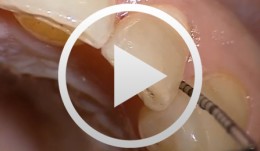

Minimally Invasive Treatment of Periodontitis (Surgical Treatment of Recurrences)
Beck, FrankContents: When treating recurrent periodontitis surgically, the challenge is to sacrifice as little soft tissue as possible in esthetically critical areas. This surgical case demonstrates the technique used in patients with narrow approximal spaces. -

-
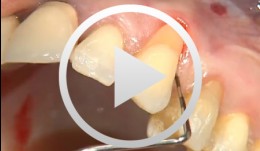
Covering a Recession with a Soft Tissue Transplant
Heinz, Bernd / Jepsen, SörenObjectives: Use of a soft tissue graft for recession coverage at tooth 23 and for gingival augmentation. Content: 1. Incision around tooth 23, intra-sulcular preparation, mobilization of coronal sliding flap, and pre-flap preparation. 2. Root smoothing, reduction of ground cavity with diamond burs from Perioset system. 3. Preparation and harvesting of connective tissue flap from palate, Emdogain application, and wound closure. 4. Placement of interrupted interdental sutures for fixation of connective tissue flap. -
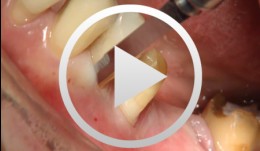
Periodontal Preserve Therapy (Examples)
Clotten, StefanContent: - Periodontal maintenance therapy for teeth 34 and 35, including the regeneration of a bone defect using bone replacement material, collagen membrane and sutures. - Curettage for treatment of periodontal pockets. - Treatment of gingival pressure sores caused by tight-fitting orthodontic apparatus. - Incision of buccal attachment to relieve gingival pressure for elimination of gingival recession. -
-
Flap surgery using a modified papilla preservation technique
Salvi, Giovanni E.Outline - Introduction: Patient history, clinical findings, diagnoses, etiology, prognosis of individual teeth - Treatment planning for phases - Modified papilla preservation technique (MPPT) - Simplified papilla preservation technique (SPPT) -Clinical situation 6 months postoperatively -
Treatment of a palatal class II furcation
Marggraf, ErwinOutline: - Reflecting a flap - Cleaning. - Fraction 3 - Fraction 2 - Fraction 1 - Wound closure List of materials All materials required for producing PRGF (BTI Germany) Bone replacement materials Geistlich Biomaterials Surgical instruments, Aesculap Suture materials, Ethicon -
Recession coverage with coronally positioned flap
Zucchelli, GiovanniOutline: - Aesthetic treatment of multiple gingival recessions List of materials Microblade BUSM-6700 (Stoma) and 15C Swan Morton, Periosteum elevator Free, De Wijs, Molt (Stoma), Curettes minifive 11-12, 7-8 (LM), Pinzette stright 17cm 0,6 (stoma), Neddle holder micro Barraquer straight 18cm extra fine (stoma), Micro-scissor Gomel, curve, 16cm extra fine (stoma), Suture Vicryl 6-0 (V384) -
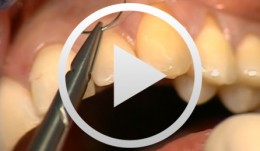
Esthetic Periodontal Treatment with Microsurgical
Wachtel, HannesContents - Instruments and planning - Incision - Split thickness flap preparation - Harvesting connective tissue for grafting - Palatal sutures - Transplant insertion and suture - Microsurgical suture Synopsis: Microsurgical operation to repair two adjacent, exposed root surfaces. The video demonstrates step-by-step how to prepare a coronally advanced split-thickness flap with subepithelial connective tissue. To remove connective tissue from the palate, a horizontal incision is required. Ultra-precise microsurgical suturing is the key to obtaining aesthetically perfect results. -
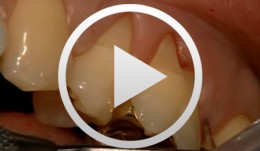
Regenerative Therapy for Multiple Recessions
Heinz, BerndContents - History - Emdogain Application - Incision - Periosteal Incision - Root Smoothing - Suture Technique - PrefGel Application Synopsis: Regenerative periodontal surgery with Emdogain enamel matrix protein: The goal of regenerative periodontal surgery is to rebuild destroyed periodontal structures. Bone transplants, bone replacement materials, and nonresorbable and resorbable membranes have been and still are being used. In a new therapeutic approach to periodontal regeneration, the root surface is conditioned using an enamel matrix protein derivative (Emdogain, Biora). The protein complex stimulates the regeneration of root cement, which in turn leads to the regeneration of bone and collagen fibers. Since the early 1980's, Professor Lars Hammerström's Swedish research team has performed extensive research and studies on this method and its mode of action. Emdogain is now used for treatment of vertical bone defects and furcation defects. The exposed root surface is first carefully scaled using handheld instruments or a rotating, fine-grain diamond drill. PrefGel EDTA suspension (Biora) is then applied for 2 minutes, then thoroughly rinsed with physiological saline solution. The EDTA suspension serves to remove the smear layer and opens the dentinal tubules, leading to improved binding of Emdogain to the root surface. Emdogain is applied to the blood- and saliva-free root surface immediately after rinsing. Finally, the wound is sutured closed. -
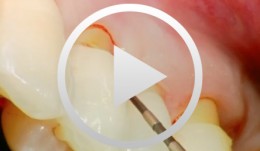
YAG Laser Applications
Schwarz, FrankContents - Laser - Basic Concepts - Principles of Fluorescence Measurement - Nonsurgical Periodontal Therapy - Surgical Periodontal Therapy - Treatment of Cervical Dentin Hypersensitivity Synopsis The primary goal of periodontal therapy is to remove bacteria-laden dental plaque otherwise that will lead to progressive decay. In addition to the classic forms of periodontal therapy, laser modalities have also been proposed in recent years. The Er:YAG laser appears to be the most promising laser system for the treatment of marginal periodontitis. Several studies have demonstrated this laser's excellent ability to remove subgingival calculus without producing thermal effects in adjacent tissues. In addition, controlled clinical studies have shown that the Er:YAG laser leads to a signifi cant increase in clinical attachment in both nonsurgical and surgical periodontal therapy. Preliminary clinical results indicate that this minimally invasive tool permits instrumentation of very deep and fl at pockets (eg, when removing root cement or in patients with increased gingival recession) without injuring hard and soft dental tissues. This live operation video demonstrates use of the Er:YAG laser for both nonsurgical and surgical periodontal therapy. -
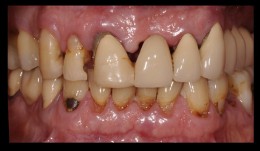
Extensive replacement of old and insufficient restorations
Dr. Dominik BüchiThis patient treated by Dr. Büchi came to our office because he was bothered by the low esthetics and masticatory performance of his dental works.